
Psychological Assessment
What Is a Psychological and Cognitive Assessment?
A psychological assessment is a structured process for understanding a person’s mental abilities, emotions, and behaviour. A cognitive assessment focuses on thinking skills, such as:
- Intellectual Ability and Reasoning
- Memory
- Attention and Concentration
- Processing Speed
- Language Skills
- Planning, Organising, and Problem-Solving
Assessment is not just a test. It combines interviews, observation, questionnaires, and standardised tasks to build a comprehensive understanding of an individual's strengths and areas of difficulty.
Types of Assessment
Depending on the concerns and questions being addressed, an assessment may involve:
- Cognitive or Intellectual Assessment: Examines general thinking and reasoning abilities.
- Learning and Educational Assessment: Evaluates reading, writing, spelling, mathematics, and study skills.
- Attention and Executive Function Assessment: Examines focus, organisation, planning, and self-control.
- Memory Assessment: Evaluates how well a person learns, stores, and recalls information.
- Emotional and Behavioural Assessment: Explores mood, anxiety, behaviour, and coping skills.
- Developmental Assessment: Evaluates how a child's cognitive, communication, social, and other developmental skills are progressing.
Your psychologist will recommend the most appropriate combination of assessments based on your individual needs and concerns.

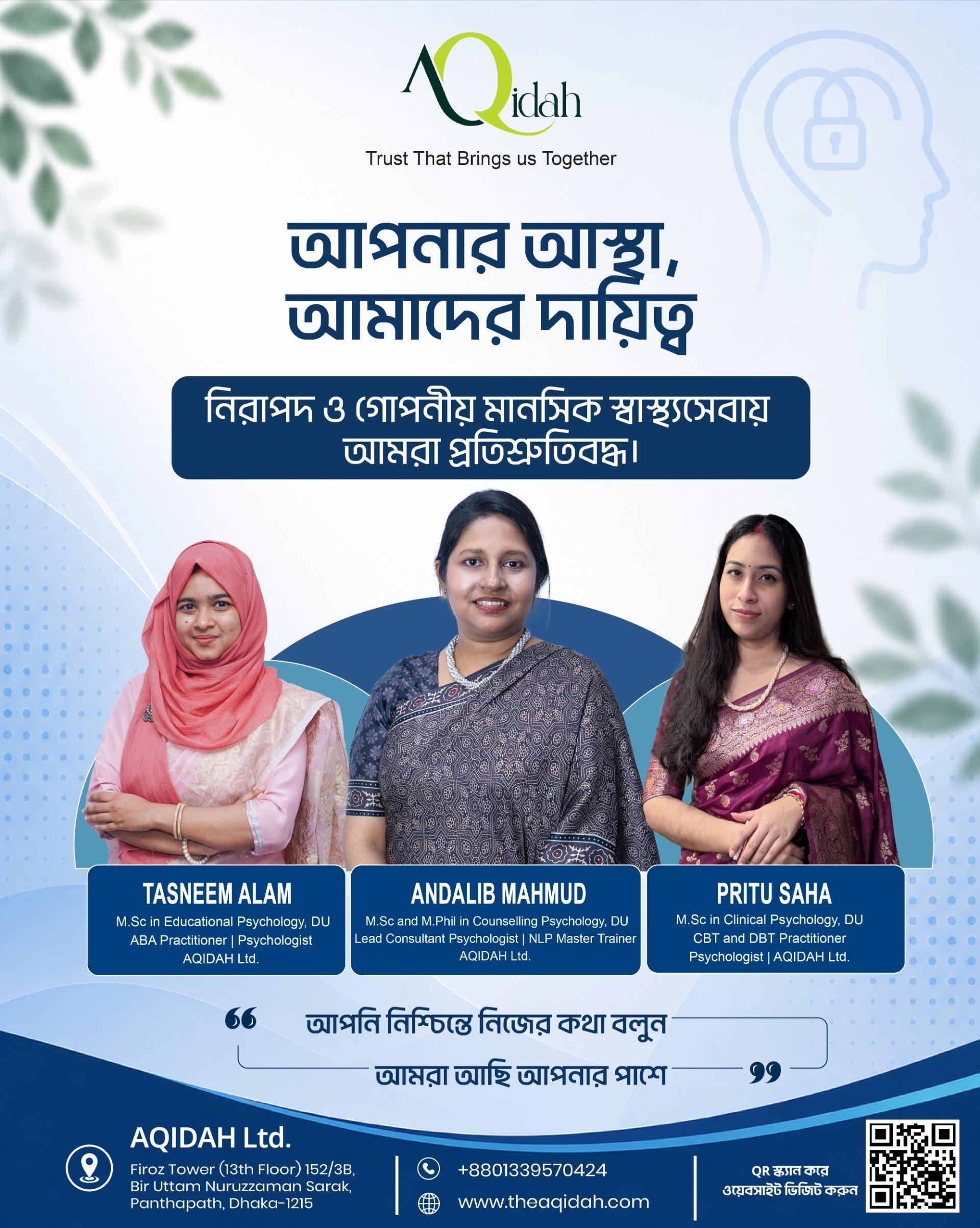
Andalib Mahmud
Lead Consultant Psychologist, AQIDAH Ltd.
Qualifications:
B.Sc in Psychology (NU), M.Sc (DU), MPhil (DU) in Counselling Psychology, Master Trainer of Neuro-Linguistic Programming (NLP).
Areas of Expertise:
- Counseling, Cognitive Behavior Therapy (CBT)
- Trauma,
- Grief & Loss
- EMDR
- Relationship Issues
- Transactional Analysis Therapy
- NLP
Andalib Mahmud brings extensive academic qualifications and specialized therapeutic expertise to her practice. Whether you are coping with severe trauma, navigating a difficult loss, or trying to rebuild personal relationships, her evidence-based therapeutic approaches including CBT and EMDR help clients regain confidence and emotional stability.
Appointment Time: Saturday to Thursday ( 10 AM to 8 PM)
Book Now

Tasneem Alam
Educational Psychologist & ABA Practitioner, AQIDAH Ltd.
Qualifications:
B.Sc in Psychology (DU), M.Sc in Educational Psychology (DU), ABA Practitioner.
Areas of Expertise:
- Behavior Management
- ADHD Screening & Behavioural Support
- IQ & Cognitive Assessment (WISC-IV)
- Exam Stress & Performance Anxiety
- Conversion Disorder Support
- Emotional Regulation and Parent Counselling
For parents, students, and young adults facing educational or behavioral challenges, Tasneem Alam provides specialized guidance. Her expertise ranges from ADHD screening and cognitive assessments to helping students manage exam anxiety and building effective behavioral strategies for home and school life.
Appointment Time: Saturday to Thursday ( 10 AM to 8 PM)
Book Now

Pritu Saha
Clinical Psychologist, AQIDAH Ltd.
Qualifications:
BSc in Psychology (DU), MSc in Clinical Psychology (DU).
Areas of Expertise:
- Anxiety Disorders
- Panic Disorder
- OCD
- Major Depressive Disorder
- Personality Disorders
- PTSD
- Sleep Disorders
- Conduct Disorder
- Addiction
- Couple & Family Issues
- Parenting, and Anger Management
Pritu Saha specializes in clinical mental health conditions and interpersonal struggles. From managing severe mood disorders like depression and OCD to supporting families with relationship dynamics, parenting, and anger management, her broad clinical range provides tailored care for long-term recovery.
Appointment Time: Saturday to Thursday ( 10 AM to 8 PM)
Book Now
Who Can Benefit?
Children and Teenagers
- Struggling with reading, writing, spelling, or mathematics.
- Having difficulty with attention, concentration, or staying organised at school.
- Being academically bright but consistently underperforming.
- Experiencing concerns related to development, behaviour, or emotional well-being.
- Needing assessment evidence to support school accommodations or examination arrangements, where applicable.
Adults
- Noticing changes in memory, thinking, or cognitive abilities.
- Experiencing difficulty with concentration, organisation, or planning at work or during studies.
- Having cognitive concerns following an illness, injury, or stroke.
- Wanting to understand personal strengths and difficulties for career or educational decisions.
- Having questions about ADHD, learning differences, or emotional well-being.
Why Is Assessment Useful?
- Provides Clear Answers: Instead of guessing, an assessment helps identify the factors contributing to a person's difficulties.
- Highlights Strengths: It identifies what a person does well, as well as areas where additional support may be needed.
- Guides Appropriate Support: Recommendations can be tailored to the individual's unique cognitive and psychological profile.
- Supports Necessary Adjustments: Assessment findings may help support requests for classroom accommodations or workplace adjustments, where available.
- Tracks Progress Over Time: Repeat assessments can help identify changes in abilities and monitor progress.
What Happens During an Assessment?
Step 1: Initial Discussion
The psychologist discusses your concerns, personal history, and goals with you or, in the case of children, with parents or caregivers.
Step 2: Assessment Planning
Based on the concerns identified, the psychologist selects appropriate assessment tools and explains the procedures involved.
Step 3: Testing and Observation
You or your child may complete different activities, such as puzzles, memory tasks, reading exercises, and questionnaires. Sessions are paced appropriately, with breaks when needed. For children, activities are presented in a friendly and age-appropriate manner.
Step 4: Scoring and Interpretation
The psychologist carefully analyses the results alongside the individual's history and behavioural observations. No single score is interpreted in isolation.
Step 5: Feedback and Written Report
You receive a clear explanation of the findings, along with a written report containing relevant recommendations and guidance for further support.
The time required varies depending on the type of assessment and may range from one session to multiple sessions.
How Should You Interpret the Results?
- Assessment results reflect how a person performed at a particular time and under specific conditions.
- Factors such as tiredness, anxiety, illness, and sleep difficulties can influence performance. A qualified psychologist considers these factors when interpreting results.
- Results should always be interpreted by a qualified professional rather than judged solely by numerical scores.
- Any diagnosis, where relevant, should be based on a comprehensive clinical assessment rather than a single test result.
How to Prepare for an Assessment
- Ensure the person gets a good night's sleep and has a light meal before the assessment.
- Bring glasses or hearing aids if they are regularly used.
- Bring relevant school reports, previous assessment results, and medical records.
- Explain to children that there are no pass-or-fail tasks; the activities simply help understand how they think and learn.
- Write down your main questions and concerns before the appointment.
Online vs. In-Person Assessment
Interviews, questionnaires, and some assessment procedures can be conducted online. However, many standardised psychological and cognitive tests are designed to be administered face-to-face under controlled conditions.
In-person assessment may therefore be recommended depending on the type of test and individual requirements.
AQIDAH Healthcare offers both online and in-person assessment options where clinically appropriate. Our team will guide you in choosing the most suitable format.
Myths and Facts: Psychological and Cognitive Assessment
Myth: It is just an IQ test.
Fact: IQ testing is only one part of cognitive assessment. A comprehensive assessment examines various cognitive abilities and considers personal history and behavioural observations.
Myth: Assessment results remain fixed forever.
Fact: Assessment results represent a snapshot of a person's abilities at a particular time. Skills can change with age, appropriate support, health, and practice.
Myth: A low score means a person cannot succeed.
Fact: Assessment scores help identify areas where additional support may be beneficial. They do not determine a person's potential or future success.
Myth: Assessments are only for children with difficulties.
Fact: Adults, teenagers, and high achievers can also benefit from assessments to better understand their thinking, learning, and cognitive abilities.
Why Choose AQIDAH Healthcare?
At AQIDAH Healthcare Ltd., we believe that every individual deserves respectful, compassionate, and evidence-based care. We explain each step of the assessment process and help individuals and families understand what the results mean in everyday life.
Our approach focuses on identifying individual strengths, understanding areas of difficulty, and providing practical recommendations for appropriate support.
With access to services including psychiatry, speech and language therapy, ADHD and autism assessment, and behavioural support, individuals and families can receive coordinated care based on their needs.
Frequently Asked Questions (FAQs)
1. Is a cognitive assessment the same as an IQ test?
No. An IQ test is one component of cognitive assessment. A comprehensive assessment examines several abilities, including memory, attention, reasoning, and problem-solving, rather than focusing on a single score.
2. Will the assessment label my child?
The purpose of assessment is understanding, not labelling. It helps identify a child's strengths, difficulties, and areas where additional support may be beneficial.
3. Can adults have a cognitive assessment?
Yes. Adults may benefit from cognitive assessments to understand concerns related to memory, concentration, thinking abilities, and work-related or academic difficulties.
4. How long does it take to receive the assessment report?
The time required depends on the type and complexity of the assessment. Your psychologist will provide an estimated timeline when you book your appointment.
5. Do I need to prepare my child for the assessment?
Yes, gentle preparation can help. Explain that your child will participate in activities such as puzzles and memory games, and that they can ask for a break whenever needed.
Related Services at AQIDAH Healthcare
- ADHD Assessment and Management
- Autism Assessment
- Multidisciplinary Assessment and Care
Take the First Step Today
Understanding how you or your child thinks, learns, and processes information can be an important step towards receiving the right support.
Book a Psychological and Cognitive Assessment with AQIDAH Healthcare today.
Aqidah Healthcare
Firoz Tower (13th Floor), 152/3B, Bir Uttam Nuruzzaman Sarak, Panthapath, Dhaka-1215
Book an Appointment: +8801339570424
Website: www.theaqidah.com